
“`html
The Hidden Checklist for Health News: How to Separate Science from Sensationalism
In an era where information travels faster than a heartbeat, we are constantly bombarded with “miracle cures,” “breakthrough treatments,” and “hidden dangers” in our diets. One day, coffee is the secret to longevity; the next, it is linked to heart palpitations. This constant flip-flopping of health advice can lead to “headline fatigue,” leaving readers skeptical or, worse, dangerously misinformed.
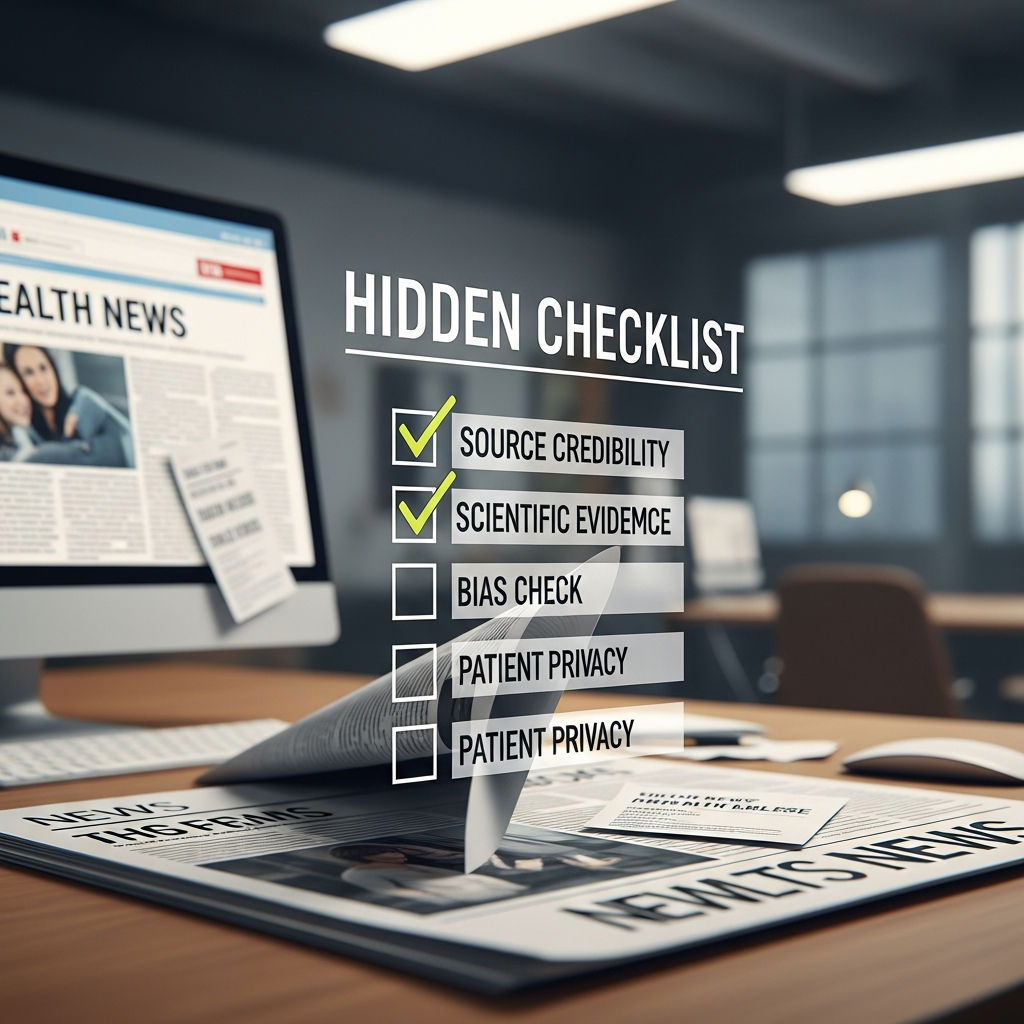
The truth is that medical science is an incremental process, but journalism often demands a definitive narrative. To bridge the gap between complex laboratory findings and snappy social media headlines, consumers need a filter. This is the hidden checklist for health news—a set of critical questions and red flags that will help you determine whether a news story is a life-changing discovery or just another clickbait trap.
Why Your Health Literacy Matters More Than Ever
Misinterpreting health news isn’t just a matter of intellectual curiosity; it has real-world consequences. People may stop taking vital medications based on a scary headline or start unproven supplement regimens that interact poorly with their existing health conditions. By mastering the hidden checklist, you empower yourself to make decisions based on data, not drama.
1. Is the Study Based on Humans, Mice, or Petrie Dishes?
The most common “hidden” detail in health reporting is the subject of the study. Headlines frequently scream “New Compound Cures Cancer” without mentioning that the study was conducted on cells in a lab (in vitro) or on laboratory mice (in vivo).
- In Vitro: Just because a chemical kills cancer cells in a glass dish doesn’t mean it won’t also kill the human patient or be neutralized by the human digestive system.
- Animal Models: While mice share much of our DNA, they are not small humans. Thousands of “breakthroughs” in mice fail to translate to human biology during clinical trials.
Always look for the mention of “human clinical trials” before getting excited about a new medical development.
2. Correlation Does Not Equal Causation
This is the golden rule of science literacy. An observational study might find that “people who drink green tea live longer.” However, this does not mean green tea *causes* longevity. It could be that people who drink green tea also tend to exercise more, smoke less, and have higher incomes—all of which contribute to a longer life.
When reading health news, ask: Did the study *prove* that Action A caused Result B, or did it simply notice they happened at the same time? Randomized Controlled Trials (RCTs) are the gold standard for proving causation, while observational studies are better for identifying trends that require further investigation.
3. The Sample Size: Who and How Many?
If a study only includes ten people, the results could easily be a statistical fluke. A robust health study requires a large, diverse sample size to ensure the results are applicable to the general population.
Furthermore, look at the diversity of the participants. For decades, many medical studies were performed exclusively on men, leading to a lack of understanding regarding how certain diseases or medications affect women. If a study on heart disease only looked at 50-year-old men, its findings might not apply to a 30-year-old woman.
Understanding the “N” Number
In scientific papers, the sample size is often denoted as “n=.” A study where n=2,000 is significantly more reliable than one where n=20. If the news article doesn’t mention the number of participants, that’s a major red flag.
4. Relative Risk vs. Absolute Risk: The Math of Fear
Health news loves to use “Relative Risk” because it sounds more dramatic. For example, you might read: “Eating processed meat increases your risk of X cancer by 50%!” That sounds terrifying. However, you must look at the Absolute Risk to understand the real impact.
- Relative Risk: A 50% increase sounds huge.
- Absolute Risk: If your original risk of that cancer was 2 in 1,000, a 50% increase makes it 3 in 1,000.
In this context, your risk only increased by 0.1%. When a headline uses percentages, always ask: “50% of *what*?” Understanding the baseline risk prevents unnecessary panic.
5. Check the Source: Who Funded the Study?
Science requires funding, and unfortunately, funding can introduce bias. This is known as “funding bias” or the “industry effect.” While not every industry-funded study is flawed, it is a crucial piece of the checklist.
If a study claiming that dark chocolate improves cognitive function was funded by a major chocolate manufacturer, you should approach the findings with a healthy dose of skepticism. Reputable journalists will disclose conflicts of interest, but if they don’t, a quick search for the original study’s “Declarations of Interest” section can be eye-opening.
6. Peer Review: The Quality Control Filter
Before a study is accepted as “science,” it should ideally go through a peer-review process. This means other experts in the same field have scrutinized the methodology, the data, and the conclusions for errors.
During the COVID-19 pandemic, “pre-print” servers became popular. These allow scientists to share findings quickly before peer review. While helpful for rapid information sharing, pre-prints are not “settled science” and are frequently corrected or even retracted later. If a news story is based on a pre-print, take it with a grain of salt.
7. The “Single Study” Trap
Science is a marathon, not a sprint. A single study is rarely enough to change medical guidelines or public health policy. True scientific consensus is built over decades through Meta-Analysis and Systematic Reviews—papers that look at hundreds of different studies to see what the collective data actually says.
If a news report claims a single study “overturns everything we knew about nutrition,” it is almost certainly exaggerating. Science moves in small steps, not giant leaps.
Red Flags to Watch For in Health Reporting
- Superlatives: Words like “miracle,” “cure,” “magic,” or “instant.”
- Anecdotal Evidence: Relying on one person’s “success story” rather than data.
- Sensationalist Headlines: Headlines that pose a question like “Is your toaster killing you?” (The answer is usually “no”).
- Lack of Links: If the article doesn’t link to the original peer-reviewed study, they might be hiding something.
How to Be Your Own Health Editor
Becoming a savvy consumer of health news doesn’t require a medical degree. It requires curiosity and a bit of “digital hygiene.” Before you share a health-related post on social media or change your lifestyle based on a news segment, take sixty seconds to run through this checklist.
Ask yourself: Is this too good to be true? Does the article mention the limitations of the study? (Good science writing always includes a “limitations” section). Is the journalist trying to inform me or scare me?
Conclusion: Empowered, Not Overwhelmed
The goal of the hidden checklist for health news isn’t to make you cynical about science. On the contrary, it’s designed to help you appreciate the rigors of the scientific method. By filtering out the noise of sensationalist reporting, you can focus on the high-quality, evidence-based information that truly matters for your well-being.
Next time you see a headline that makes your heart race, remember: check the subjects, look for the absolute risk, and always wait for the peer review. Your health—and your peace of mind—are worth the extra effort.
“`