India Air Pollution Plan Falls Short
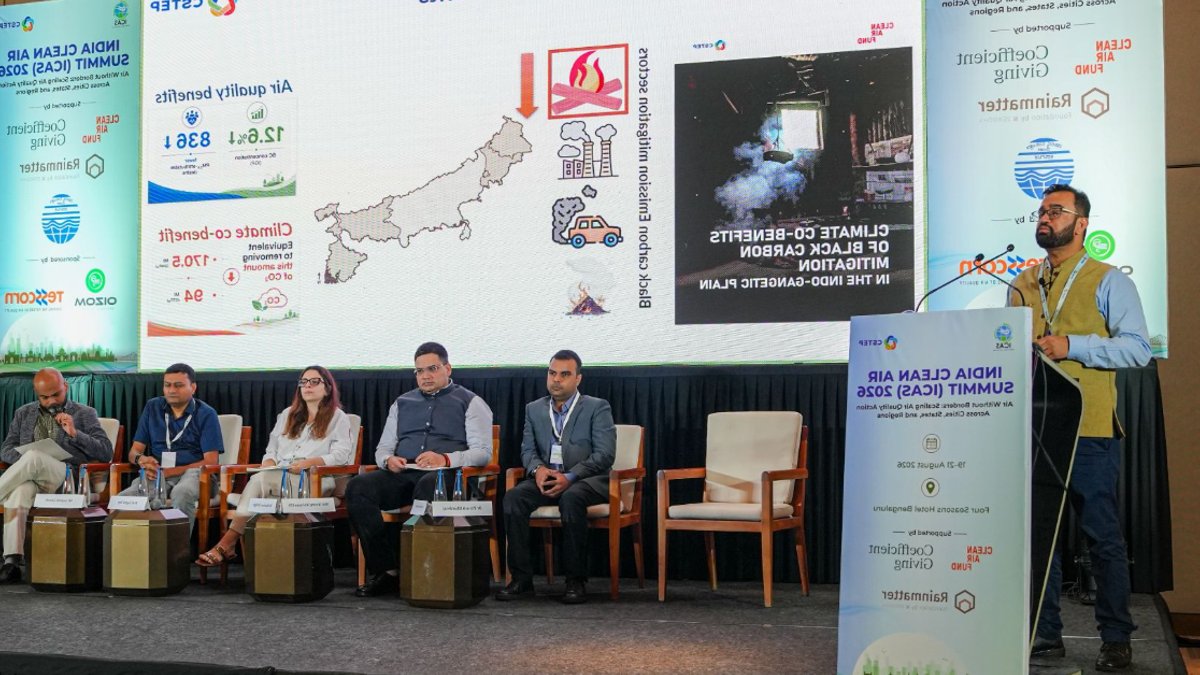
India’s flagship air pollution action plan, the National Clean Air Programme (NCAP), has failed to deliver, according to research presented at the eighth India Clean Air Summit. The program, launched in 2019, aimed to reduce pollution by 40% by 2025-26 in 131 targeted cities.
Data shared by the summit organizer, the Center for Study of Science, Technology and Policy (CSTEP), showed that fewer than 7% of these cities met the goal, and 35% of cities showed an increase in coarse particulate matter (PM10).
The NCAP’s limited impact stems from several core design flaws, including its focus on cities and PM 10, rather than the finer, deadlier PM2.5 particulate matter pollutant. The program also lacks a systemic assessment of interventions and covers short-term measures rather than long-term planning.
About 95% of India’s PM2.5 pollution is emitted from cities and rural areas that are excluded from the NCAP’s focus. Seventy percent of PM2.5 is from “non-urban areas,” according to PAVITRA, an air quality management tool developed by IIT Bombay, CSTEP, and two American universities.
Experts emphasized that future iterations of the program must bridge air pollution control measures with climate action policies. At least two government experts warned of emerging, interconnected feedback loops between climate change and air quality.
Ratish Menon, a senior official of Kerala’s Pollution Control Board, requested that the next version of the NCAP, “NCAP 2.0,” include funds for cities that are not yet non-attainment but are trying to prevent becoming one.
The Indo-Gangetic plain, which stretches about 2,000 kilometers across northern India, is described as an “emission hotspot” by SD Attri, a senior official and scientist of the Commission for Air Quality Management (CAQM).
A sharper focus on just two states, Uttar Pradesh and Bihar, and one pollutant, black carbon or soot, has been recommended by a CSTEP report. The largest source of black carbon is from homes burning biomass and other dirty fuels for cooking and heating.
Reducing black carbon emissions can save lives, and the largest benefits are to be achieved through a multisectoral airshed approach. Reducing black carbon emissions from all major sources in the IGP results in a reduction in black carbon concentration and prevents premature deaths.
Piyush Bharadwaj, head of the air quality observations and modeling group at CSTEP, noted that the mortality burden estimated in the study is conservative because the exposure–response function used is derived for ambient PM 2.5 mass concentration rather than for individual PM 2.5 components.
The CSTEP report also highlights significant co-benefits between clean air initiatives and carbon mitigation. In a best-case scenario, aggressive black carbon reduction in northern India would yield climate co-benefits equivalent to a significant amount of CO2, roughly similar to a country’s annual emissions.
Dr. Ratish Menon attributed part of the rise in Kerala’s air pollution levels to pollution from neighboring states, but also to global warming. Last winter’s peak in air quality monitoring stations was more because there was lesser wind transport between the land and ocean, he says, “because the ocean temperatures are increasing and that exchange is getting affected.”
A separate climate link was flagged by a senior scientist at IIT Kanpur, SN Tripathi, whose team has overseen the deployment of almost 1,400 low-cost sensors in Uttar Pradesh and Bihar. They are seeing that a good part of these two states have a “very high amount of this compound index,” which combines temperature and relative humidity to provide a universal climate index.
As India’s peak pollution season begins in October, officials are calling for urgent changes in air quality management. The government has released over INR 16,423 crore to support the NCAP, but the program’s effectiveness remains a concern.
Abinaya Sekar of Health Effects Institute stated that assessing the effectiveness of air pollution interventions is necessary, offering a framework on how to do this. CSTEP researchers urged the government to integrate air quality targets into both NCAP 2.0 and India’s international commitments under the UN Nationally Determined Contributions (NDCs).
Aligning these policies would allow air quality improvement to be recognized as a critical element of near-term climate mitigation, particularly by targeting short-lived climate pollutants like black carbon. The demand for better implementation has been a constant theme in the India Clean Air Summit, and it remains to be seen how the government will respond to these concerns.
They will need to make significant changes to address the air pollution issue in India, which is closely linked to global health concerns.
The government’s response to the concerns raised at the India Clean Air Summit will be key in determining the effectiveness of the NCAP.
It is essential to address the issue of air pollution in India to improve public health and reduce the economic burden of pollution-related illnesses, as seen in the lives of people with ostomy.

African Readiness For New TB Vaccines


