Nepal Floods Highlight Climate Risks for Developing Nations
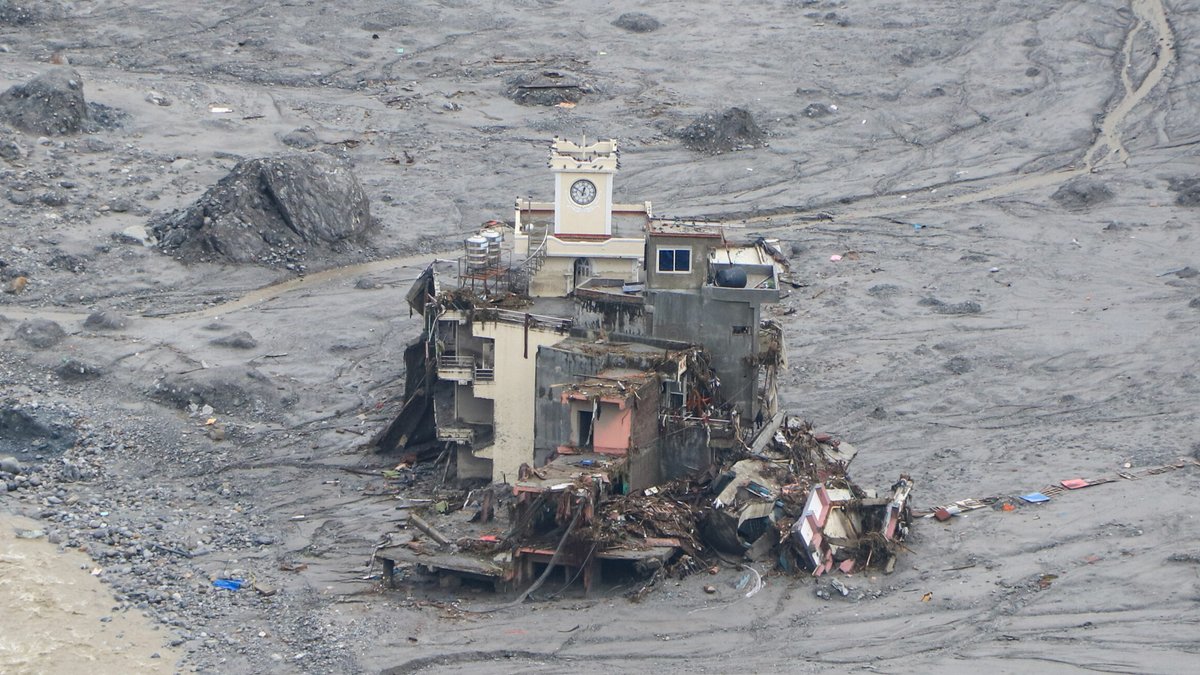
Floods flattened nearly everything in its path near Betrawati, Rasuwa, leaving only a few homes standing. Shekhar Lamichhane, a 65-year-old asthma patient, struggles to breathe as he mourns the loss of family members swept away in the flash flood on August 26. The disaster was triggered when glacial ice and rock slammed into the valley near the Nepal–China border. He now shelters on a terrace just above the floodwaters, relying on relief workers to charge his electric oxygen concentrator.
Lamichhane described the terrifying sound of the rushing water. “It was making a sound like a helicopter makes. It was like all clouds and dust running high in the sky. The river climbed up the mountains on both sides and took everything in its way.” Preliminary estimates suggest the mass of bedrock and glacier ice broke off a slope north of Langtang Lirung and fell roughly 1,200 meters—about four times the height of the Eiffel Tower. The debris slammed into the Lhende River, which flows from Tibet into Nepal, sending water and rubble surging downstream.
Why early warnings failed
Dr Farooq Azam, a Senior Cryosphere Specialist at ICIMOD, described the event as an unprecedented, sudden-onset hazard. He noted there was no detection and no time to issue a warning. A rapid assessment by the International scientists from HiRisk agreed. They stated that warning times for the border checkpoint at Rasuwagadhi would have been minimal and insufficient for evacuation. The event registered as a 5.2-magnitude earthquake on the US Geological Survey.
Related: Afghan Lives Caught in Taliban West Conflict
However, the report indicates that further downstream, full systems could have saved lives with just 10 minutes of warning. The scientists point out that while some pre-event signs—such as visible brown meltwater by August 24 and cracks in bedrock—were present, the systems in place were not designed to interpret these signals quickly enough. The HiRisk report notes that while some glacial lake monitoring systems were recently set up in China, no operational systems exist specifically for glacier-related hazards.
The tragedy exposes a gap between technological fixes and physical reality. While sensors can monitor water levels, they cannot predict when a mountainside collapses in seconds. The vulnerability here stems from a combination of physical hazards and land-use decisions that placed settlements in areas historically considered unsafe. “Early warning systems are being sold as the fix, but no siren can outrun a mountainside collapsing in seconds,” said Professor Anjal Prakash of FLAME University in India and an IPCC author.
Scale of destruction
By September 1, the death toll exceeded 1,003 people, with nearly 4,000 reported missing. Satellite imagery from Copernicus shows the devastation in Syapru Besi, a mountain village in Rasuwa District. Preliminary assessments indicate that at least 68 bridges were hit, including 33 suspension bridges and 35 motorable bridges. Additionally, 40 kilometers of highway were washed away, severing critical transport links.
Related: RSV and maternal vaccines protect European health
Open-access datasets show that 12,944 buildings are located within the floodplain, with structural heights reaching up to 9 meters. The flooding also impacted black carbon levels in the region. Black carbon concentrations have increased by approximately 7.74% since 2000, contributing to faster warming of the glaciers. This pollution is a regional problem that accelerates the melt of ice in the Himalayas.
Disproportionate impact and emissions
Simon Stiell, the executive secretary of UN Climate Change, called the floods a reminder of the fragility in the Hindu Kush Himalayas. He noted that scientists and local communities have warned of the region’s risk for years. Nepal serves as a stark example of how small nations face disproportionate climate impacts despite low emissions. The country gets nearly all its electricity from hydropower, though warming trends are affecting the region.
According to Our World in Data, Nepal emitted only 0.05% of the world’s CO2 emissions in 2024. Despite contributing the least to the problem, the nation bears the brunt of the consequences. Stiell emphasized that while the event was sudden, the solutions to global heating require a faster shift from fossil fuels to renewables and greater investment in climate resilience.
Related: African Readiness For New TB Vaccines
Relief efforts and response
Nepal’s government faced criticism for a slow response to international assistance. Government spokesperson Sasmit Pokharel rejected these claims. He said the Ministry of Foreign Affairs is in contact with countries and constantly assessing the situation. Rescue teams from India, China, South Korea, and others are already on the ground supporting search-and-rescue operations.
Pokharel addressed concerns about the handling of bodies. Due to limited space and technology, some unidentified remains were moved to Chitwan. However, officials stated that DNA samples, fingerprints, and details are documented and stored before burial. He emphasized that doors are open for relatives to claim the bodies if they come forward.
Stiell reiterated that the solutions to global heating require a faster shift from fossil fuels to renewables and greater investment in climate resilience. The region continues to grapple with the physical aftermath of a disaster that could not be predicted, leaving communities to rebuild in the fragile Himalayas.

Afghan Lives Caught in Taliban West Conflict


